

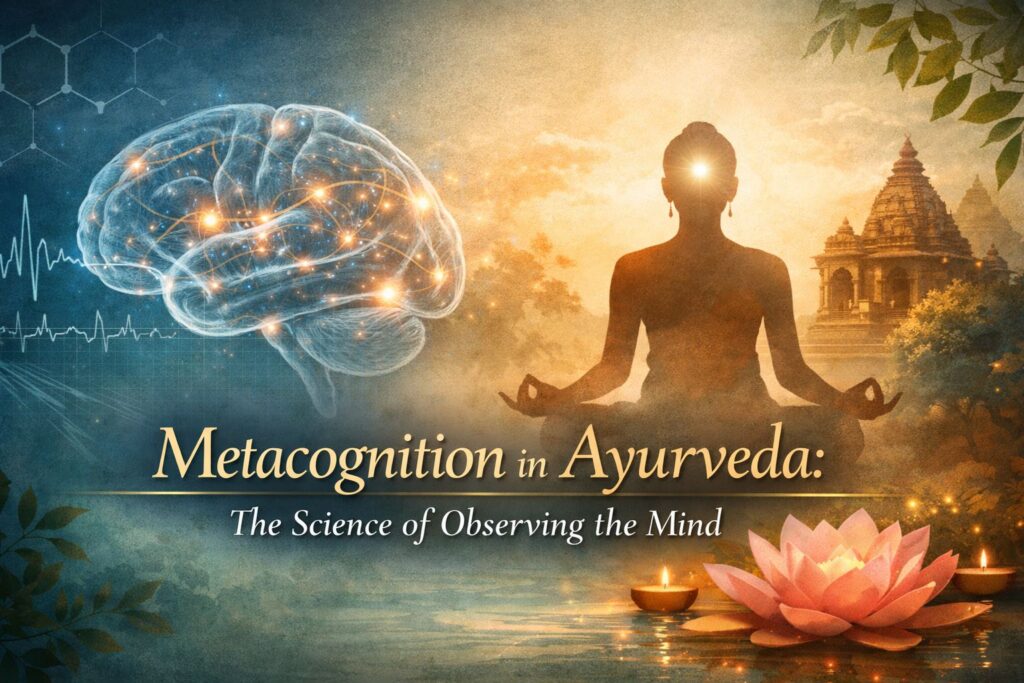
In the process of healing, one of the most subtle yet transformative abilities a person can develop is the capacity to observe their own internal state. This does not refer to analysis alone, but to a quiet recognition of thoughts, reactions, and emotional patterns as they arise.
In Ayurveda, this state of inner observation is closely related to the cultivation of mental clarity and stability. The mind is not viewed as separate from the body, but as an extension of the same system—deeply influenced by the condition of the nervous system and the balance of doshas, particularly Vata.
Vata governs movement, including the movement of thoughts and nerve impulses. When Vata is disturbed, the mind tends to become reactive, scattered, and easily overwhelmed. In such a state, awareness is often replaced by automatic responses. One reacts before understanding, speaks before reflecting, and feels before grounding.
The ability to pause and observe interrupts this pattern.

In modern neuroscience, this capacity is often referred to as metacognition—the ability to become aware of one’s own thinking processes. It involves recognizing thoughts as they arise, questioning reactions, and creating a space between impulse and response. Research suggests that this form of awareness engages higher regions of the brain associated with self-regulation and reflection.
While this terminology is relatively recent, the underlying principle is not new.
Ayurvedic and yogic traditions have long described a similar state of awareness, often referred to as the witnessing mind—a condition in which one observes mental activity without immediate identification or reaction. Rather than being carried by every thought or emotion, the individual develops the capacity to remain steady, even as internal fluctuations arise.
From a physiological perspective, moments of conscious awareness allow the system to shift away from constant reactivity. Instead of being driven by impulse, the individual begins to create space between stimulus and response. Within this space, regulation becomes possible.
However, this process is not always comfortable. Observing one’s own reactions requires stillness, honesty, and a willingness to face internal fluctuations without distraction. For many, the discomfort arises not from the thoughts themselves, but from the act of witnessing them without avoidance.
For this reason, self-awareness cannot be separated from nervous system stability. A dysregulated system will struggle to observe without becoming entangled. True observation arises more naturally when the body is supported through grounding practices.
Ayurveda offers simple yet effective methods to create this foundation:
• Warm oil application to stabilize Vata and reduce internal agitation
• Slow, rhythmic breathing to regulate the flow of prana
• Exposure to calming sensory input, including gentle sound and visual stillness
These practices do not force awareness, but prepare the system to sustain it.
Over time, as the nervous system becomes more balanced, observation becomes less effortful.
One begins to notice patterns without immediately identifying with them. Reactions soften, and responses become more intentional.
In this way, what modern science describes as metacognition can be understood not as a separate skill, but as a natural outcome of internal balance—one that has long been recognized within Ayurvedic wisdom.
Healing, therefore, is not only the correction of external symptoms, but the refinement of inner perception.
To observe the mind clearly is to begin understanding the root of imbalance—and from that understanding, change becomes possible.