


Triphala: Ayurveda’s Treasured Elixir for the Eyes
For thousands of years,Triphala has stood as one of Ayurveda’s most celebrated herbal formulations for eye care. Revered by generations of Ayurvedic practitioners, its harmonious combination of three remarkable fruits—Amalaki, Haritaki, and Bibhitaki—represents a timeless tradition of cleansing, rejuvenation, and natural wellness.
Among the many preparations preserved within Ayurveda, Triphala holds a particularly treasured relationship with the eyes and vision. Simple in composition yet remarkably complex in its natural constituents, this three-fruit formulation continues to embody the depth and elegance of classical Ayurvedic herbal wisdom.

The Three Fruits of Triphala The Sanskrit word Triphala literally means “three fruits.” Its classical formulation combines three renowned Ayurvedic fruits, each contributing its own distinctive qualities.
Amalaki (Emblica officinalis)

Amalaki, commonly known as Amla or Indian gooseberry, is one of Ayurveda’s most highly regarded rejuvenative fruits. Traditionally valued for its cooling, nourishing, and rejuvenating qualities, Amalaki has long occupied an important place within Ayurvedic formulations associated with vitality and restoration.
Haritaki (Terminalia chebula)

Haritaki is revered throughout Ayurveda for its cleansing, balancing, and restorative qualities. Its distinguished history and versatility have made it one of the most respected fruits in classical Ayurvedic practice.
Bibhitaki (Terminalia bellirica)

Bibhitaki completes the remarkable Triphala combination. Traditionally appreciated for its purifying and balancing qualities, it contributes to the harmonious nature of this celebrated three-fruit formulation.
Together, Amalaki, Haritaki, and Bibhitaki create something greater than three individual herbs. Their complementary characteristics form the balanced preparation known throughout Ayurveda as Triphala.
Triphala and the Ayurvedic Tradition of Eye Care

The eyes hold a special place in Ayurveda, and Triphala has long been associated with their traditional care.
Used as a carefully prepared and thoroughly filtered traditional eye wash, Triphala has been valued for cleansing and refreshing the eyes, soothing tired or overworked eyes, and supporting their natural comfort and vitality.
Within traditional Ayurvedic eye care, Triphala is particularly appreciated for helping to:
- Gently cleanse and refresh the eyes.
- Remove accumulated dust and impurities.
- Soothe tired and visually fatigued eyes.
- Refresh the eyes after prolonged reading or visual activity.
- Support natural eye comfort.
- Maintain a fresh, bright, and clear appearance.
- Provide gentle rejuvenative care as part of an Ayurvedic wellness routine.
The beauty of Triphala lies not in complexity, but in the extraordinary harmony of its three fruits and the generations of knowledge surrounding their use.
The Rejuvenating Nature of Triphala

Triphala is traditionally regarded as a Rasayana in Ayurveda a rejuvenative formulation associated with maintaining vitality and supporting the body’s tissues.
This classification helps explain why Triphala has remained so deeply respected within Ayurvedic tradition.
Its qualities are not described simply as cleansing. Triphala is traditionally valued for bringing together cleansing, nourishment, balance, and rejuvenation within one formulation.
For the eyes, this gentle and balanced character is particularly significant. Rather than representing aggressive intervention, traditional Triphala eye care reflects Ayurveda’s philosophy of preserving and supporting the natural vitality of the eyes through thoughtful, regular care.
Traditional Homemade Triphala Eye Wash

Traditional Triphala eye wash may be prepared from the three fruits Amalaki, Haritaki, and Bibhitaki using a simple overnight infusion.
Triphala is placed in purified water and allowed to infuse overnight, giving the water sufficient time for a gentle aqueous extraction of the herbal constituents.
The following day, the preparation is carefully filtered until the infusion is clear and completely free of herbal particles.
This beautifully simple process reflects the essence of traditional herbal preparation: three treasured fruits, pure water, time, and careful attention.
Because the eyes are exceptionally delicate, cleanliness and thorough filtration are essential when preparing a traditional eye wash. A preparation containing visible sediment or herbal particles should not be placed in the eyes.
The Natural Complexity of Triphala

Although Triphala appears remarkably simple, modern phytochemical investigation reveals a much more intricate botanical formulation.
Scientific literature has identified numerous naturally occurring constituents within Triphala, including gallic acid, ellagic acid, chebulinic acid, tannins, and flavonoids such as quercetin and luteolin.
These naturally occurring compounds have attracted considerable scientific interest, particularly because Triphala and its constituents have been investigated for antioxidant, anti-inflammatory, antimicrobial, and immunomodulatory activities.
Modern science is therefore beginning to examine, through contemporary analytical methods, the biochemical complexity of a formulation that Ayurveda has treasured for generations.
Triphala, Antioxidants, and Scientific Interest in Eye Health

The traditional relationship between Triphala and the eyes has also attracted scientific attention.
A 2017 review published in the Journal of Alternative and Complementary Medicine, titled Therapeutic Uses of Triphala in Ayurvedic Medicine, discusses Triphala’s phytochemistry, antioxidant properties, traditional applications, and scientific research concerning eye health.
The review describes Triphala as rich in polyphenolic compounds and discusses research examining antioxidant activity and oxidative processes relevant to the lens.
This is particularly interesting because oxidative stress is an important area of modern scientific investigation in relation to ocular tissues.
The scientific literature does not replace Ayurveda’s traditional understanding of Triphala. Rather, it offers another perspective from which researchers can investigate the remarkable botanical composition of this ancient formulation.
Triphala and the Microbiome: A Fascinating Modern Discovery
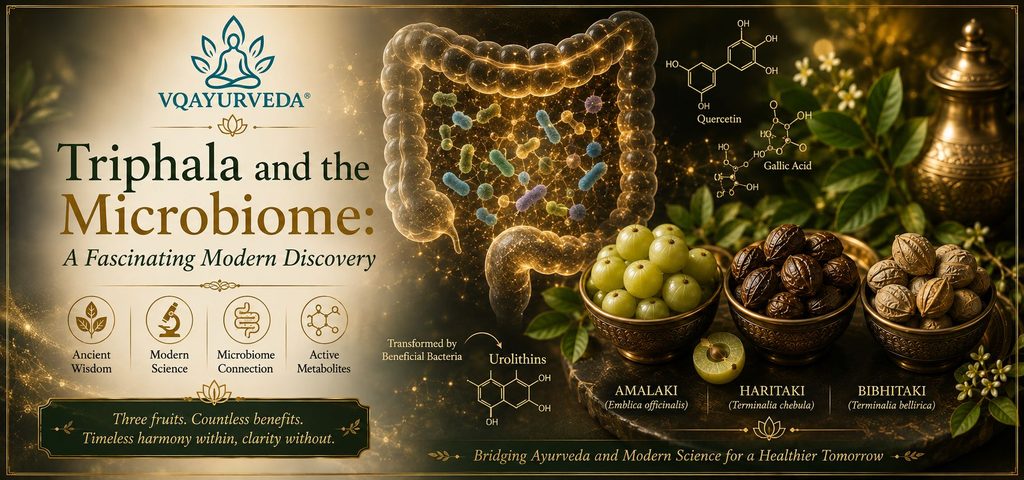
Modern research has uncovered another intriguing dimension of Triphala.
The 2017 scientific review discusses the relationship between Triphala’s phytochemicals and the intestinal microbiome.
Compounds associated with Triphala, including quercetin and gallic acid, have been investigated for their interaction with intestinal microorganisms. The review discusses evidence concerning beneficial bacterial groups such as Bifidobacteria and Lactobacillus and the influence of Triphala phytochemicals on the microbial environment.
Even more fascinating is the ability of intestinal microorganisms to transform certain Triphala-derived polyphenolic compounds into other biologically active metabolites, including urolithins.
This research relates to Triphala when consumed, rather than its traditional external use as an eye wash, but it demonstrates just how biologically complex this seemingly simple three-fruit formulation truly is.
Ancient Knowledge Through a Modern Lens: Triphala was not created by modern science.
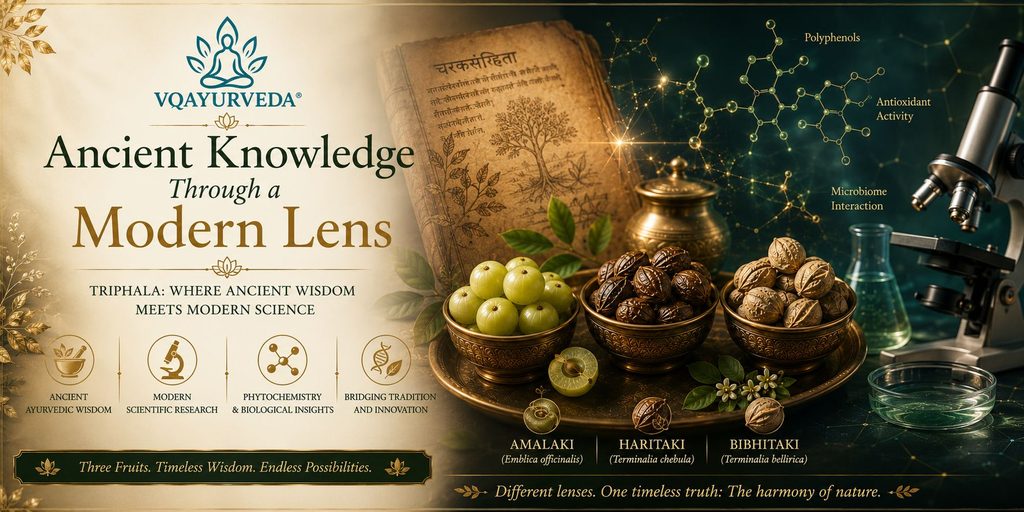
Its history belongs to the ancient Ayurvedic tradition, where generations of practitioners preserved knowledge of this remarkable combination of Amalaki, Haritaki, and Bibhitaki.
Today, scientists can identify its polyphenols, examine its antioxidant properties, investigate its interaction with microorganisms, and explore the biological activities of its individual constituents.
These investigations provide a modern scientific lens through which an ancient formulation can be studied.
Ayurveda and contemporary science therefore offer different ways of examining Triphala: one through centuries of traditional knowledge and practice, and the other through phytochemistry, laboratory investigation, and modern biological research.
Respecting the Delicacy of the Eyes

Traditional Triphala eye wash should be prepared with exceptional cleanliness and filtered thoroughly before use. Any preparation that appears cloudy or contains visible herbal particles should not be applied to the eyes.
It is also important to distinguish traditional wellness care from the treatment of an eye disorder.
Individuals experiencing eye pain, injury, sudden changes in vision, persistent redness, discharge, or other concerning symptoms should seek prompt evaluation from an eye-care professional.
Traditional Triphala eye wash is an Ayurvedic wellness practice and should not replace professional diagnosis or treatment when an eye condition requires medical attention.
The Enduring Legacy of Triphala
Perhaps the true magnificence of Triphala lies in its endurance.
Across generations, cultures, and changing approaches to health, the same three fruits—Amalaki, Haritaki, and Bibhitaki—have remained united within one of Ayurveda’s most celebrated herbal formulations.
Modern researchers can now identify and investigate many of Triphala’s natural constituents, yet the formulation itself belongs to a much older tradition of Ayurvedic knowledge.
For thousands of years, Triphala has stood as one of Ayurveda’s most treasured herbal formulations for eye care. Revered by generations of Ayurvedic practitioners, its harmonious blend of Amalaki, Haritaki, and Bibhitaki represents a timeless tradition of purity, rejuvenation, and gentle support for the natural comfort and vitality of the eyes. Its enduring legacy reflects the remarkable wisdom of classical Ayurveda and the lasting confidence placed in this extraordinary three-fruit formulation.
Three fruits. One extraordinary formulation. A timeless Ayurvedic treasure for the eyes.
Scientific Reference
Peterson CT, Denniston K, Chopra D. Therapeutic Uses of Triphala in Ayurvedic Medicine. Journal of Alternative and Complementary Medicine. 2017;23(8):607–614. doi: 10.1089/acm.2017.0083.
Read the full scientific review on PubMed Central